|
|
|||||||||||||||||||||||||||||||||||||||
|
|
|||||||||||||||||||||||||||||||||||||||
|
Disparities in Avoidable Mortality During the COVID-19 Pandemic Associated
with |
|||||||||||||||||||||||||||||||||||||||
|
Authors:
Michael
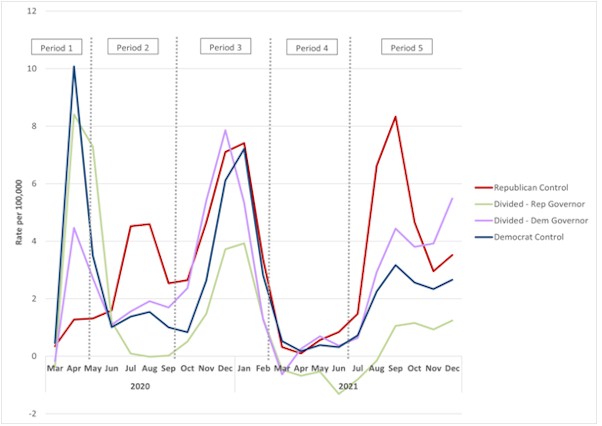
A. Stoto, Derek A. Chapman, Five years after the beginning of the COVID-19 pandemic, analysts are still questioning whether the benefits of lockdowns, other restrictions, and vaccines outweighed the harms, and even whether these public health strategies “worked” at all. With almost any disease, mortality and other outcomes are determined by public attitudes and behaviors as well as policies, and all of these changed over the course of the pandemic in complex ways. Consequently, sorting out the effects of specific interventions is statistically challenging if not logically impossible. During the pandemic there was a sharp partisan divide in states’ messaging about and implementation of pandemic control policies, as well as the public’s attitudes and willingness to change personal behaviors and be vaccinated. Because Republican-leaning states tended to have lower vaccine uptake and higher mortality, the phenomenon came to be labeled “Red Covid” in the summer of 2021, although state policies, implementation, behavior, and outcomes had started to diverge at least a year earlier. This created a kind of natural experiment in which different patterns of attitudes, policies, behaviors, and outcomes associated with partisan orientation emerged among the U.S. states. While there were certainly economic, social, and educational benefits associated with the less restrictive policies in Red states, it is appropriate to ask how they compare to the number of deaths avoided. Our recent paper takes advantage of this natural experiment to assess the impact of non-pharmaceutical interventions as well as vaccines. Specifically, we find that between the June 2020 and November 2021 more than half a million deaths could have been avoided, disproportionately in Republican controlled states, potentially reflecting differences in attitudes, policies, and behaviors. We also find that almost 300,000 avoidable deaths occurred before vaccines were widely available, potentially reflecting earlier relaxation and weaker implementation of non-pharmaceutical interventions in the same states. While disparities in mortality cannot be associated with any particular policy or political action, they demonstrate that combinations of public health strategies collectively made a substantial difference in COVID-19 outcomes and undercut the argument that public health strategies did not work at all. Partisan differences in COVID-19 mortality rates Excess mortality rates — the difference between observed all-cause mortality and predicted mortality based on pre-pandemic seasonal trends — were obtained from the Centers for Disease Control and Prevention. An analysis of these rates led us to identify five periods during which epidemiological patterns and available interventions varied: 1. Initial outbreak (March – May 2020): deaths concentrated in Northeastern states 2. Summer 2020 (June – September 2020): infections spread nationwide and enforcement of non-pharmaceutical interventions (NPIs) began to differ 3. Alpha wave (October 2020 – February 2021): Alpha variant drove surges in COVID-19 cases and implementation of NPIs grew deeply polarized 4. Early vaccine (March – June 2021): vaccines introduced, initially for older adults and other at-risk populations 1. Delta wave (July – November 2021): Delta variant drove large surges, and vaccine uptake differed sharply by state. As in our earlier research, we grouped states into four categories reflecting different levels of partisan control: states with “trifectas,” in which either Democrats or Republicans held the governor’s seat and controlled both chambers of the legislature, and states with divided government, in which the governor’s party controlled no more than one chamber. Figure 1. Avoidable deaths by partisan control of state government.
We then calculated avoidable mortality rates for each state by subtracting from excess mortality rates the average rate in the 20% of states with the lowest excess death rates in each period. We did not include the initial outbreak period in these calculations because low mortality rates were likely not the result of policies but rather that the virus had not yet arrived in many states. On this basis, we calculated that 553,672 deaths could have been avoided. Table. Number of avoidable deaths and rate (per week * 1000) by partisan control of state government and period
More than half a million US deaths could have been avoided had all states experienced the excess mortality rates of the best-performing quintile of states. The nation’s avoidable death toll was sizable, roughly double Faust and colleagues’ estimate of excess deaths associated with racial-ethnic disparities. Similarly, Stoto and colleagues found that more than 400,000 deaths could have been avoided if each of four census regions experienced the lowest reported rate by region.
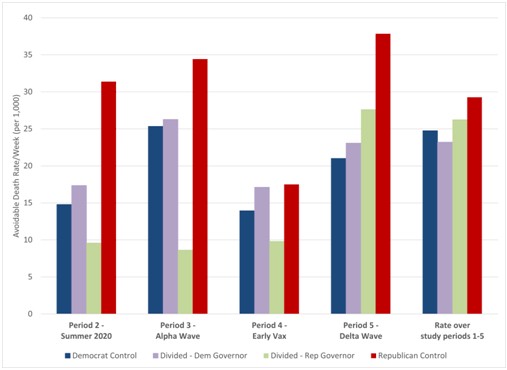
Figure 3. Avoidable death rate per week per 1,000 population by partisan control of state government. Pre-vaccine period
The “Red Covid” label
arose in the summer of 2021, focusing on disparities in vaccine
uptake. However, almost 300,000 avoidable deaths occurred before
vaccines were available, with significantly higher rates in
Republican-controlled states (Figure 3). Avoidable death rates were
3.5 times as high in states with solid Republican control than states
with Republican governors and divided legislatures. A regression
analysis found that only partisan control and minority status were
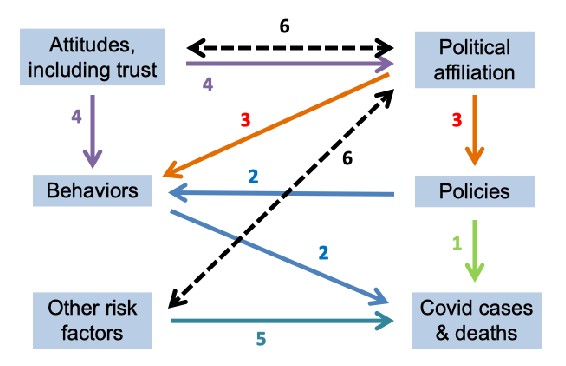
significant predictors of avoidable mortality rates. Post-vaccine period The nation experienced 257,584 avoidable deaths in periods 4-5, after highly effective vaccines were available. Rates and disparities between the four categories were relatively low in Period 4 but surged in Period 5 (Delta wave), when avoidable mortality rates were almost twice as high in states with solid Republican control than in solidly Democratic states. A regression analysis found that the poverty rate, the urban vs rural population ratio, and partisan control (including an interaction between the latter two factors) were the only significant predictors of avoidable mortality. Overall, vaccines prevented more than 3 million deaths in the U.S through November 30, 2022. The disparity among the states in avoidable death rates during periods 4-5, accounting for 257,584 avoidable deaths, was likely due primarily to sharp differences by state in vaccine uptake, especially in younger adults. These differences emerged in the summer of 2021 when vaccines were first offered to those under age 65. Vaccine uptake was uniformly high among the most vulnerable in the first half of 2021; had partisan disparities emerged in period 4, the loss of life would have been much higher. Similarly, after December 2021 there were minimal differences among the states in COVID-19 mortality rates, presumably because by then nearly everyone had acquired some level of immunity through previous infections or vaccination. Vaccine mandates appeared in the summer of 2021, but were mainly at the federal level or in specific populations (e.g. healthcare workers), so probably did not contribute significantly to state differences. The role of epidemiologic evidence Without the opportunity to conduct randomized trials, it is difficult to draw conclusions about the impact of public health control strategies. This analysis demonstrates the importance of appropriate data and rigorous study methods. Earlier studies examined aggregate data, often without distinguishing among phases of the epidemic when both the level of transmission and the availability of effective interventions varied. Most studies of the Red Covid phenomenon focused on differences in vaccine uptake, and examine simple bivariate associations even though outcomes were influenced by other state-specific factors ranging from demographic, socioeconomic, and health care characteristics to public attitudes and behaviors and the co-occurrence of multiple policies that shifted over time. In addition, we based our analysis on excess mortality rates rather than reported Covid mortality rates. The latter are differentially undercounted in Red states, obscuring differences in actual mortality. However, isolating the effect of policies, behaviors, attitudes, and political affiliation is immensely complex. One cannot analyze the impact of policies (arrow 1 in Fig. 4) without considering individual behavior as an intermediate factor (2). Political affiliation presumably influences which policies are adopted as well as compliance (3). Attitudes (including trust) determine both individuals’ political affiliation and their behavior (4). Analysts must also account for the influence of demographic, socioeconomic, and other risk factors (such on Covid outcomes (5). And both attitudes and these other factors are associated with political affiliation, with the direction of the causal arrow unclear (6). Considering that multiple policies were implemented at different times, that attitudes and behaviors also vary over time and within a state, it is simply not possible to sort out the causal relationships, either statistically or conceptually. Our analysis does, however, demonstrate that the “Red Covid” phenomenon (the combination of Republication identification, less trust, Covid denialism, weaker policies, less compliance, more cases and deaths) emerged earlier than thought, and calculate its magnitude.
Conclusions State-level disparities in mortality rates are shaped by multiple variables — ranging from demographic, socioeconomic, and racial-ethnic characteristics to access to health care and the prevalence of health behaviors and preexisting conditions — but partisan choices made by state policymakers and the public are likely to have contributed to mortality trends during the pandemic. In this respect, we found that more than half a million deaths could have been avoided during the pandemic if all states had experienced the excess mortality rates of the best-performing quintile, and the majority – 320,162 – occurred in states with Republican governors and legislatures.
In addition, we found
that almost 300,000 deaths could have been avoided before vaccines
were widely available. While this study was not designed to measure
the impact of any specific policy action, but rather to describe
patterns in outcomes associated with partisan choices made by state
policymakers and the public.
|
|||||||||||||||||||||||||||||||||||||||
|
|
|||||||||||||||||||||||||||||||||||||||