|
|
|||||||||||
|
|
|||||||||||
|
Gun Violence, Domestic Violence |
|||||||||||
|
Authors:
Katelyn Jetelina, PhD, MPH
NOTE:
This article was
originally printed in Your Local Epidemiologist on April 21, 2026. To
read more content from this source subscribe to Your Local
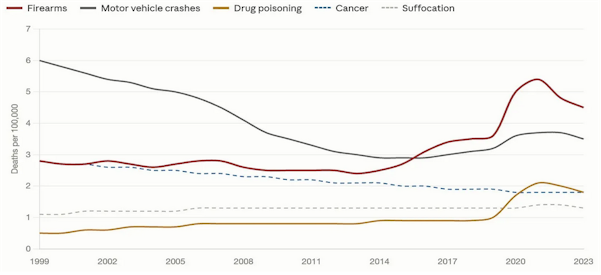
Epidemiologist (YLE): Well, I tried to sit down to write the usual “health weather report” (ticks, diseases, etc.) that comes out on Tuesdays. But a tornado-like event came roaring in over the weekend, reminding all of us of the massive public health problem Americans continue to face: Firearm violence. On Sunday, this country experienced the deadliest mass shooting in more than two years. Another tragedy and yet another headline that faded in a day. This time, a man in Louisiana killed eight children, left two women critically wounded, traumatized an entire community, and sent first responders to a scene unlike anything most of them had ever encountered. These tragedies are not random. What happened over the weekend was a predictable convergence of well-documented, preventable factors. Yet in some states, lawmakers keep failing to act on what we know. So this week’s “health weather report” is dedicated to gun violence. From me (formally trained in violence epidemiology) and Dr. Megan Ranney (a fellow expert in gun violence), here’s the forecast: what the data shows, where the most risk lies, and most importantly, what it means to you. Note: This piece covers sensitive topics, including domestic violence and suicide. Please read at your own pace, and know that resources are available at the end if you or someone you love needs support. Gun violence is still the number one killer of youth in the United States. On Sunday, a man shot and killed eight children ages 3 to 11. One child was shot on the roof while trying to escape. Unfortunately, this is not random. For these poor, sweet children, dying from a gun is not a rare occurrence for youth in the United States. Firearms are the number one cause of death for children, recently surpassing motor vehicles and remaining the leader for a few years now.
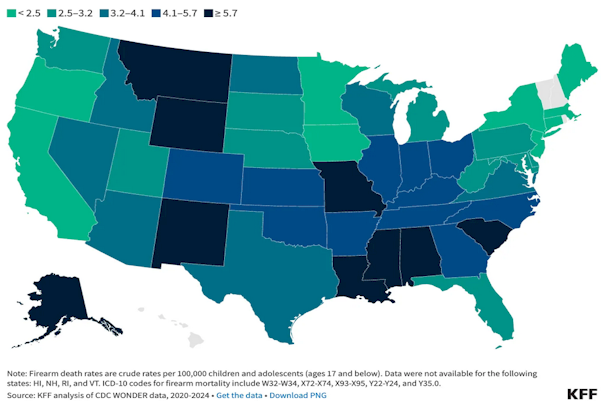
On a state level, firearm deaths are most common in the South. Louisiana specifically has the third-highest number of youth deaths from firearms in the country (8.4 per 100,000 kids), a rate that has been increasing fast (75%) in the past 10 years. This is just behind that of Mississippi (8.7 deaths per 100,000) and Washington, DC (10.1 per 100,00). These deaths include not just mass shootings, but also firearm homicide and suicide.
A history of domestic violence is a strong predictor of mass shootings. Authorities described the Shreveport tragedy as an event of domestic violence. This isn’t random, as domestic violence is at the heart of so much gun violence. In fact, 70 women are shot and killed by an intimate partner every single month in America from homicides, suicides, and mass shootings:
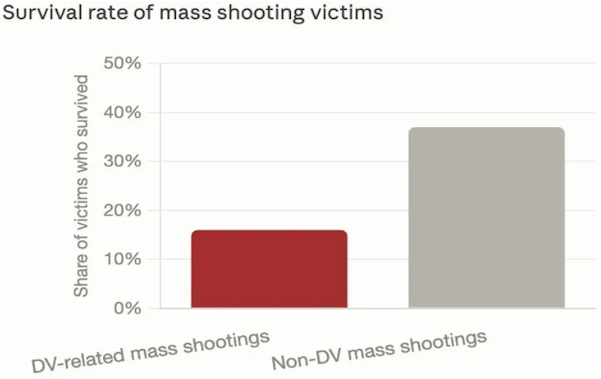
The women in Shreveport were very lucky to survive, given the odds against them. The likelihood of surviving a mass shooting is much lower when it’s related to domestic violence. That’s because domestic violence incidents are crimes of passion, determined to cause maximum harm to specific people. When someone who has already decided to kill acts with a firearm, the results are almost always catastrophic.
Domestic violence thrives in conditions of fear, hopelessness, hatred, and economic dependency—the same conditions that correlate with higher rates of gun ownership, easier access to firearms, and fewer resources for intervention. The Shreveport suspect should never have had a gun. He did anyway. The Shreveport suspect had a documented firearms arrest from 2019 and a history of domestic violence. This man should never have had a gun. We do not yet know whether he obtained his firearm illicitly, but it is all too easy to do so. Under federal law, people subject to domestic violence restraining orders (DVROs) are prohibited from purchasing or possessing firearms. This law has helped significantly, but it also has real gaps. DVROs:
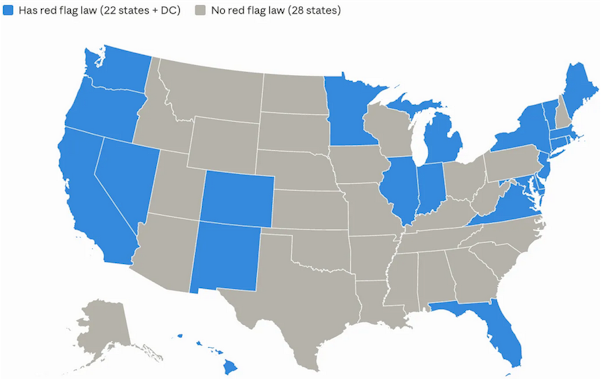
This is where red flag laws come in: an added layer of protection. ERPOs (Extreme Risk Protection Orders) allow a family member or law enforcement officer to petition a court to temporarily remove firearms from someone showing warning signs of danger. A judge reviews the evidence, and if there’s enough, the guns are removed for a defined period. This is a civil order with full due process, and the guns are returned when the risk has passed. These can work especially well in domestic violence situations because they give families and law enforcement something concrete to do in the window between “this person is dangerous” and something irreversible happening. Louisiana doesn’t have a red flag law. In fact, in 2024, its legislature actively shelved it. As shown below, twenty-two states (plus DC) have these laws.
Red flag laws seem to work. While relatively new, the evidence is growing:
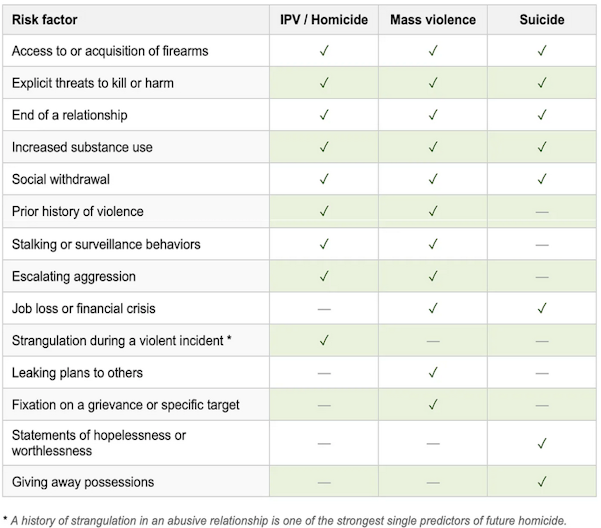
What this means for you: the systems need you too. Laws are needed. But even the strongest laws in the world are meaningless if people don’t know that they are at risk. And extensive data shows that even when people recognize risk—as the family members did in Louisiana—they often don’t feel empowered to act. In a country with 400 million firearms in private hands and an active illicit firearms market, knowing when and what to do can be a matter of life or death for our friends and family members who are in crisis. What happened in Shreveport sits at the intersection of three types of gun violence: domestic homicide, mass shooting, and suicide. Some risk factors are distinct for each type, but many are shared. Risk factors aren’t the perfect formula, but the more risk factors present, the higher the probability of a tragic firearm-related death.
If you worry that you or someone you love is at risk,
The good news Just like smoking, a massive public health problem like gun violence will take time to chip away at every angle. But progress is possible. We know this because we’re seeing it:
One YLE reader asked: “Back in the 1950s and 1960s, there were far fewer restrictions on buying a gun, and yet mass shootings were almost non-existent. How do you explain that?” Part of the answer is a data artifact. Systematic tracking of mass shootings didn’t exist before the 1980s, so many incidents that would qualify today were simply never counted. There is also just an increased awareness of these events due to changes in the information landscape. But we have strong data showing the increase is real, too. Weapons are fundamentally different: the civilian AR-15 didn’t exist until 1963, semi-automatic handguns were far less common, and there were roughly 50 million privately owned firearms in the U.S. in 1960 (0.28 guns per capita) compared to an estimated 400 million today (1.19 guns per capita). Finally, it’s about system failures—ranging from social media glorification of mass shooters, to lack of mental health care, to growing isolation and loneliness. In case you missed it Throughout the years, I’ve written about this topic in detail in YLE. A few other pieces: Bottom line Gun violence isn’t random. It’s predictable, and because it’s predictable, it’s preventable. But it requires more lawmakers to finally act on what they know. This weekend, the systems meant to protect the most vulnerable failed, and eight children paid the price. ■ For more content like this please fine YLE on Substack here: https://tinyurl.com/vhmbuyka
|
|||||||||||
|
|
|||||||||||